

Journey to the Big Room
A death and resurrection show

The answer to every important question concerning what you need to do in life is this: Go to the Big Room and plug in to the Higher Power Station. After being brought back to life by the holy current, blessings will naturally flow, including innovative, transformative participation in the everyday, now permeated with expansive thinking, warm emotion, healthy laughter, and the vibrant buzz of altered action. All is well until it isn’t, and when the latter alarm goes off, do not get lost searching for an answer in cold temperatures and shrunken psychological rooms that don’t encourage experimental tinkering and uncommon spirited action. Rather than try to change yourself or other people, aim to change the room you’re in. Head to the Big Room where ecstatic emotion and somatic motion shake everything up and get the circle of life turning in a virtuous direction again.1
We wrote that in 2019, and “the Big Room” is still our favorite name for the vast realm of holiness, the infinite field of spiritual electricity, the Ineffable Beyond where the current of creation is always humming.
Over the years we’ve seen that for many people, the greatest leap of religious faith is not believing in invisible deities or spirits. It’s trusting that if we get inside the Big Room we’ll be changed—realigned with divine mystery and recharged with its healing electricity. Faith is needed here, not because the effects of Big Room presence aren’t tangible, but because our small-room minds will continue to doubt what we can’t figure out. Or control. Lakota elder, Frank Fools Crow (c. 1890-1989) put it this way:
I submit always to Wakan Tanka’s will. This is not easy, and most people find it impossible, but I have seen the power of prayer and I have seen God’s desires fulfilled. So I pray always that God will give me wisdom to accept his way of doing things.2
I wish Big Room presence was our default condition, but a quick scan of the history of religion shows it requires effort to bring it about. In contrast, it’s annoyingly easy to feel like a Big Self squeezed into a small container crammed with all the troubles of the world plus our own worst habits. In the small room there’s no space for anything but self-observation, self-evaluation, self-reference, self-everything. We’re like a “czar in a jar,” Brad and I used to say.
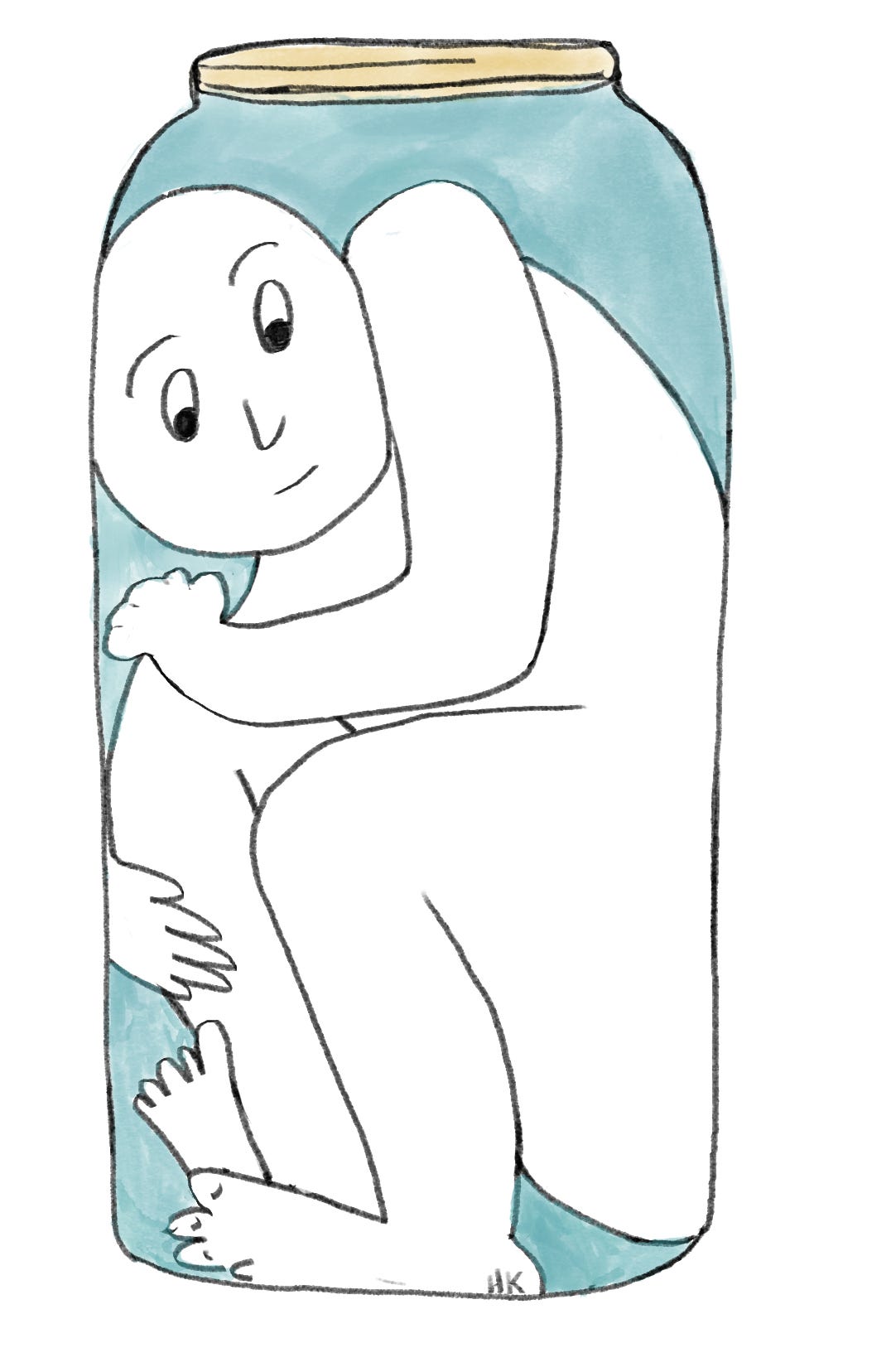
“Please un-jar this czar.
Amen.”
Old wisdom warns that a Big Me in a small room eventually causes suffering. Not only for ourselves (there we go again) but also for others. I don’t mean to imply we’re all walking around like jarred pickled dictators wreaking sour havoc on the world. Only some of us are doing that. I’m pointing to a basic but radical dynamic: the size of our existential space shapes our experience far more than our presumed “inner” psychological condition.
If you’ve ever entered a sacred context and suddenly felt your emotions, perspective, and sense of reality change in a profound and ineffable way, then you likely know what I’m talking about.
Regular visits to the Big Room help us get through hard times, stay on track during good times, and act wisely with our relations during all times. Accepting Wakan Tanka’s will? Almost impossible without room-expanding prayer, according to Grandpa Frank.
In his long life of global spiritual sojourns, Brad endured all manner of old-way gateways to the Big Room: fasting, sweating, freezing, long ceremonies, ingesting things, battling ghosts, and…camping. You can imagine the Providence that was required to get this man to sleep in a tent. However, he also got to enjoy dancing and singing all night in the Kalahari and all day Sunday in praise houses and country churches. In every case, Brad respected whatever beliefs, names, and traditional methods a culture employed to cross over from the small here to the big there.
Though his experiences generated many miraculous and supernatural tales, Brad was in it for the tender surrender, not the wild adventure. He experienced firsthand that resituating one’s life inside a vast, holy context radically and magically changes things. His words:
All experienced ecstatic shamans know that their shamanism is a ‘death and resurrection show.’ They allow their burdens, shortcomings, failures, illnesses, mistakes, sins, and crimes to bury them in the ground. Shamans aren’t afraid to see that they are no better than any criminal behind bars, and that no one is any better than or superior to any other living creature, whether it is a rat, snake, or insect. Understanding where we really are in the grand scheme of things humbles us in a good way and helps us give up any arrogant notion that we are capable of winning any battle, internal or external, on our own. In this coming to terms with our true situation, we are leveled.
Consequently, our self-importance experiences a momentary death. Overcome by the data, it surrenders and says, ‘I am nothing.’ In this existential death, the shaman sincerely reaches out to a greater wisdom, a higher being, and begs for help. ‘I surrender my soul to Thee. Take me, make me, and shake me.’ These are prayers of surrender and requests for transformation.
This is when the biggest magic takes place. When we humble ourselves and ask for help with utmost sincerity, our whole being becomes a lightning rod, ready to be struck by rejuvenating lightning...we are spiritually revived and set onto a new course of living.3
This new course involves regular re-surrender and re-entry to the Big Room. Not just to feel saner, happier, or avoid spiraling into a dark pit (though these are good enough reasons), but so that when we’re called on to help, we’ll know how to reach across the threshold, grab hold of a higher hand, and bring more of God’s fresh mystery into the situation and less of the canned self.
I’m writing this during March N/omastery Month in the Sacred Ecstatics Guild. The n/omastery is a virtual monastery saturated with n/om, the Kalahari Bushman word for the sacred life force. More than usual this month we aim to disrupt our small room maintenance habits and increase our daily concentration on electrical, Big Room re-entry.
Several mini death-and-resurrection shows per day is what we’re aiming for.
While the occasional retreat from regular routines has its benefits, the n/omastery arrives not to remove us from the world but to open the door to the universe, right here in the thick of things. To walk through that door we must creatively carve out more time to pray, move, and perform mystical prescriptions with sufficient emotion and concentration until…bang! We’re un-jarred, realigned, and recharged again, at least for a while.
The shamanic or n/omastic life is not about achieving a constant state of perfect wisdom bliss, it’s about remembering this: We walk on the finite, time-bound ground but we belong to the infinite, eternal Big Room. Whenever you feel the pinch, open the door and head Home.
Peace on earth,
Hillary & Brad
Thank you for re-stacking and hitting the ❤️
Further reading:


From our 2019 book, Sacred Ecstatics: The Recipe for Setting Your Soul on Fire.
From Frank Fools Crow: Wisdom and Power, with Thomas E. Mails.
https://bookshop.org/p/books/shaking-medicine-the-healing-power-of-ecstatic-movement-bradford-keeney-ph-d/f433d592cae5a937?ean=9781594771491&next=t
I wrote this while the world is on the brink of nuclear war. Every night Brad and I listen to experts discuss current events. We hear the fear, anger, and despair in their voices and it matches those feelings within us. We head to the Big Room not to avoid facing the dire straits we're in, but to give us the strength we need to keep living and responding in whatever way we can. Not going to let the crusaders of cruelty keep us from letting the Light in and following the old-way wisdom tracks left by those who came before us.
Amen amen amen! Always perfect timing for me, your missives are. Thank you!